In the metalworking industry, the terms MIG and MAG welding are often used, but many are not entirely sure how these processes differ. Both belong to the category of Gas Metal Arc Welding (GMAW) and share a very similar working principle. The key distinction lies in the type of shielding gas used, which determines the application and the final welding result.
What is MIG Welding?
MIG (Metal Inert Gas) welding uses inert shielding gases, such as argon, helium, or their mixtures. These gases do not chemically react with the base material, resulting in a clean, oxidation-free weld.
MIG welding is primarily used for non-ferrous metals, including:
- Aluminum
- Copper
- Titanium
And other alloys where corrosion resistance and a clean welding surface are important
The process is easily automated, ensures a stable arc, and produces high-quality, aesthetic welds. Its drawbacks are the higher cost of the gases and lower efficiency in outdoor environments, where drafts can easily disrupt the shielding gas flow.
What is MAG Welding?
MAG (Metal Active Gas) welding also uses a consumable wire electrode, but the shielding gases are active, such as:
- Carbon dioxide (CO₂),
- Or argon and CO₂ mixtures.
These active gases react chemically with the molten metal, influencing the properties of the weld. MAG welding is mainly used for steel and structural materials because it’s more economical, faster, and provides higher welding speeds.
Advantages of MAG welding:
- More cost-effective operation
- Stronger welds with deeper penetration
- Suitable for outdoor and industrial environments
The downside is that the weld surface may have more spatter and oxidation, requiring post-weld cleaning or finishing.
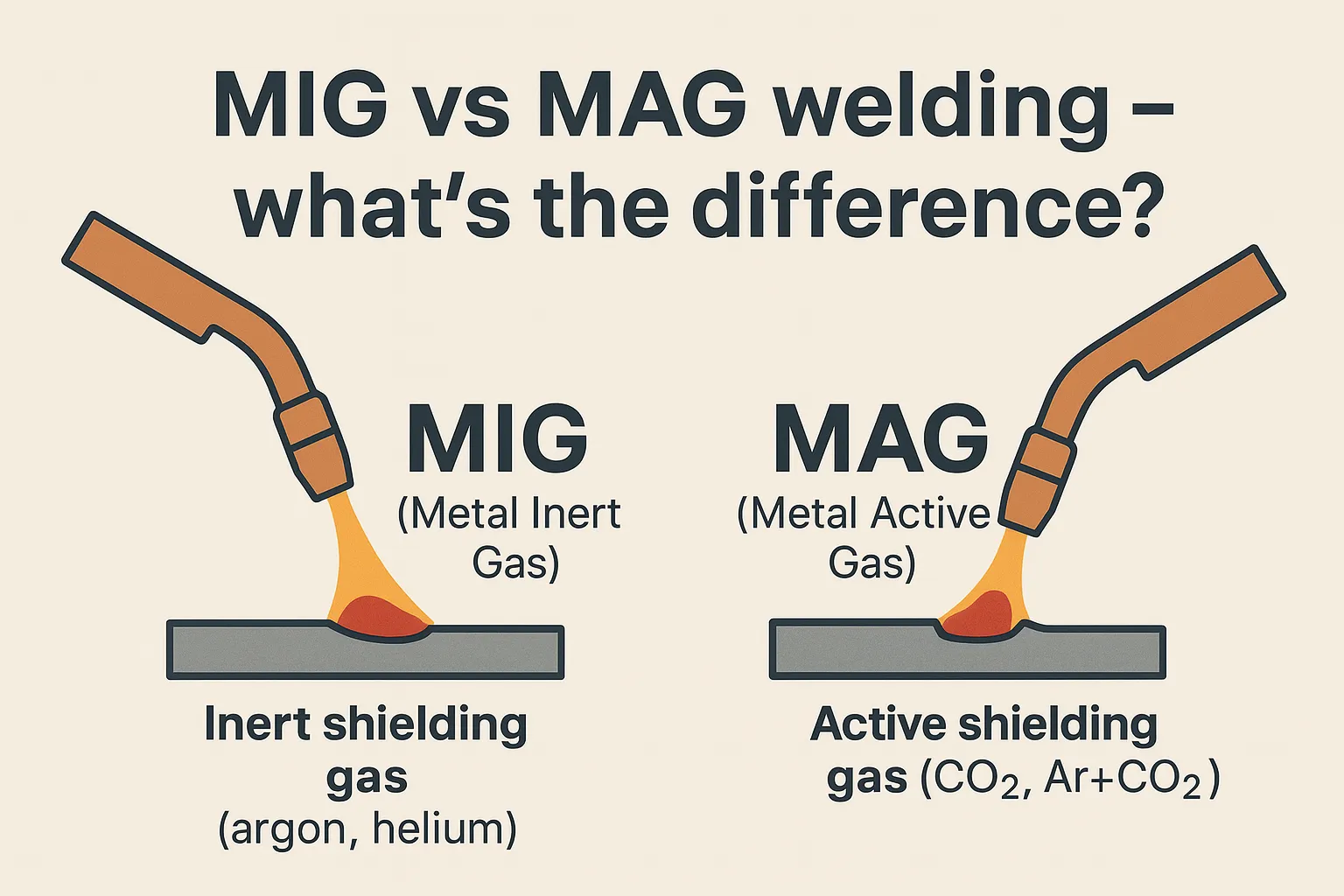
MIG vs. MAG Welding Comparison
| Property | MIG Welding | MAG Welding |
|---|---|---|
| Type of gas | Inert (argon, helium) | Active (CO₂, Ar+CO₂) |
| Materials | Non-ferrous metals | Steels |
| Weld quality | Clean, bright, oxidation-free | Strong, but more spatter |
| Cost | More expensive | More economical |
| Applications | Precision work, aluminum welding | Machinery, structural welding |
| Outdoor use | Not ideal | More suitable |

Which Should You Choose?
The right choice depends on the material you’re welding and the working environment:
- For stainless steel or aluminum, choose MIG welding for its cleanliness and precision.
- For structural steel, iron, or machinery components, MAG welding is the more practical, economical, and efficient option.
Conclusion
Although MIG and MAG welding operate on nearly the same principle, the type of shielding gas fundamentally affects the final result. MIG offers a precise, clean, but costlier process, while MAG is more robust, affordable, and versatile, making it the preferred method in most industrial applications.
Choosing the right welding method determines not only the quality of the weld but also the efficiency and cost-effectiveness of production. Always make your decision based on the material and the intended purpose.